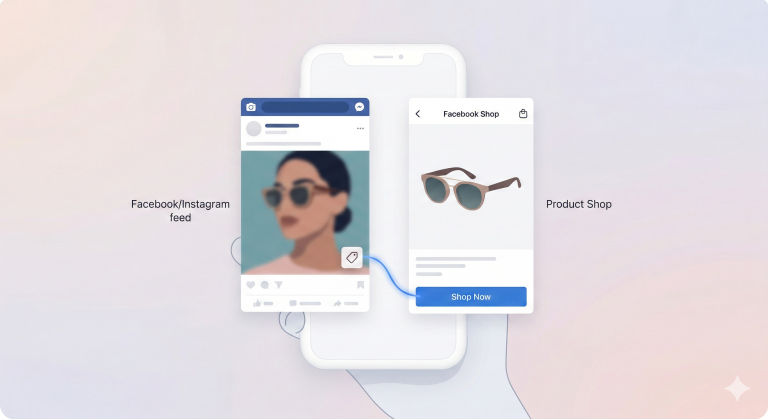
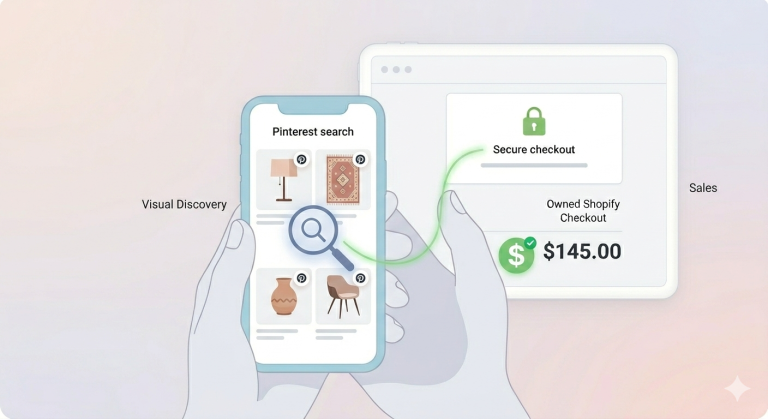
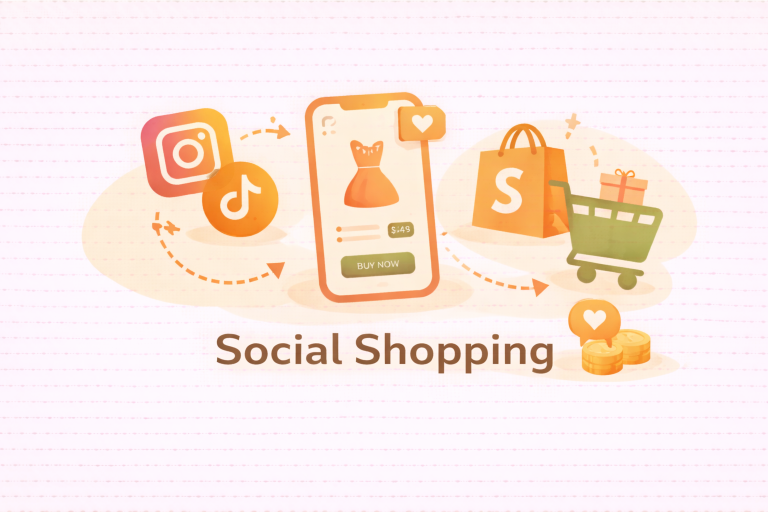
As a shoppable content platform, our job isn’t to shine. It’s to make our clients’ work sparkle, build trust with viewers, and drive epic conversions.
When shoppers see real people using and loving a product—whether through UGC, influencer features, or shoppable posts—it creates immediate social proof.
Pair this trust with an easy path to purchase and you’ve got a recipe for success.
What Should You Look for in a Shoppable Content Platform?
A high-quality shoppable content platform will include the following features:
- Integration with Shopify or other ecommerce platforms. Make sure your storefront, product catalog, and checkout process all work seamlessly with the platform.
- Support for shoppable video, live shopping, and reels. Lets you turn video content and real-time streams into clickable, purchase-ready experiences.
- UGC rights management. Secures the permission to use customer photos, videos, and other content across your marketing channels.
- Product tagging features. Links images or videos directly to specific product details, making it easy for shoppers to click and purchase instantly.
- Easy embedding into websites, emails, and storefronts. Makes it easy to display shoppable galleries and clickable content across every customer touchpoint.
- Strong analytics. Helps you track conversions, optimize campaigns, and measure the ROI of your shoppable content.
The 5 Top Shoppable Content Platforms
1. LTK: Best for partnering with proven influencers
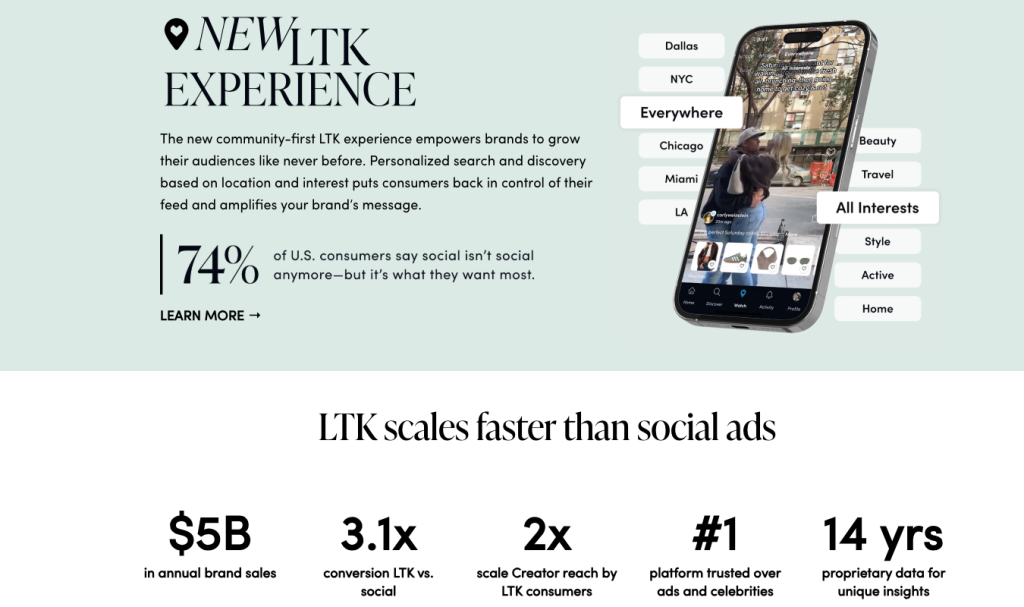
LTK is an influencer-powered, social-like app built around shoppable content. The platform connects creators with audiences that are ready to shop.
Here’s how it works:
- Influencers post their content on normal social media platforms like Instagram, TikTok, or YouTube
- They then upload those posts (with product tags) to their LTK profile
- Shoppers can follow influencers in the LTK app or click LTK links shared in social posts to browse and purchase products
LTK does have an app and a feed you can scroll. But this is more of a curated shopping experience than a place where people go to hang out and share random life updates.
Key Features:
- Access to a large network of vetted influencers already creating shoppable content in your niche
- Affiliate tracking and partnerships that allow you to pay only for performance
- Tools to source influencer-created shoppable posts you can use in your own marketing campaigns
- Analytics to track clicks, conversions, and ROI from influencer collaborations
- Integration with major social media platforms so influencer content can appear both in LTK and across their existing channels
Pros:
- Massive network of influencers
- Built-in audience for instant reach
Cons:
- Limited customization for brand storefronts
LTK is best for brands that want to partner with influencers who already have a proven track record of driving sales through their posts.
The cost to use LTK is based on a revenue-share model, which you can learn more about on the LTK pricing page.
2. Foursixty: Best for brands that want to own the customer journey
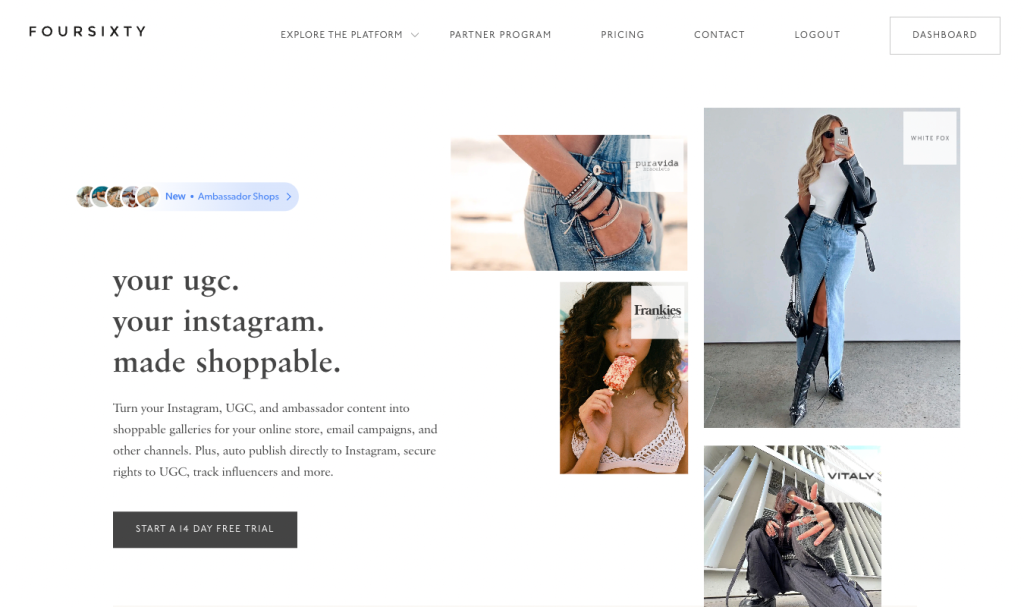
Foursixty—that’s us!—is a shoppable content platform that helps brands turn Instagram posts, TikToks, and UGC into direct sales tools. It pulls in your best-performing social content, lets you tag products, and makes that content clickable. That way, customers can shop right from what they see.
Instead of just hoping people see your product on Instagram or TikTok and remember to search for it later, Foursixty lets you:
- Collect top posts and user-generated content in one place.
- Tag your products right inside the photos or videos.
- Embed those shoppable galleries into your website, product pages, or even emails.
It works quietly behind the scenes, connecting the content people love to the checkout process.
In return, you get more clicks, more sales, and a smoother shopping journey without sending customers off your site.
Key Features:
- Curate shoppable UGC, TikToks, and Instagram posts directly into your product pages, emails, and on-site galleries
- UGC rights management so you can legally use customer and influencer content at scale
- Product tagging for a direct path to purchase from visual content
- Email embedding for Klaviyo to drive sales through every touchpoint
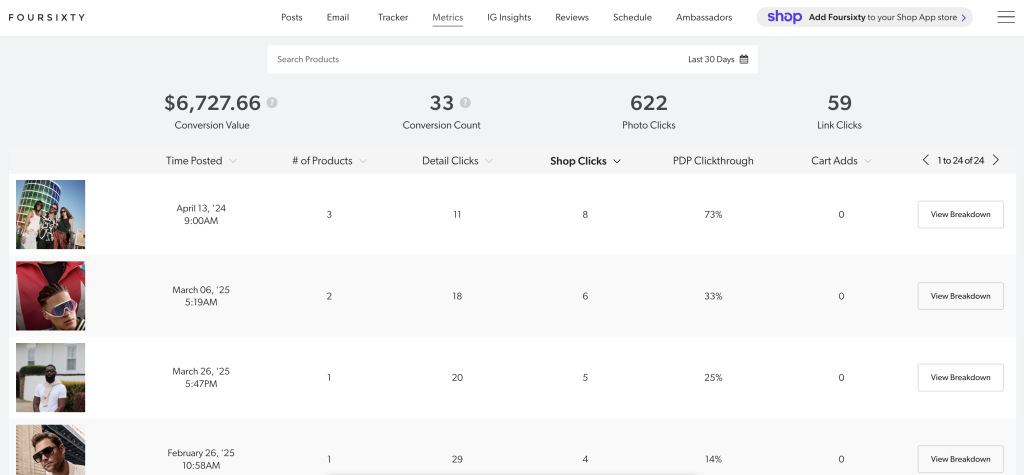
- Real-time analytics to track engagement, clicks, and conversions across all placements
Pros:
- Native integration with Shopify
- Excellent customer experience and conversion rate optimization tools
Cons:
- We strive to avoid cons, but we know our service can be a significant upfront investment—which is why we offer a free trial and three pricing tiers 🙂
Foursixty is best for brands that want to own their customer journey. With Foursixty, brands can embed shoppable UGC, TikToks, and Instagram posts directly into their product pages, emails, and website, all without sending shoppers off-platform. We’ve seen customers increase their add to cart with our integrateable seamless brand and look (customized with their site styles).
Foursixty costs $90 a month for our basic features, $300 per month for all the core features, and $500 a month for the extras. Explore plans on the Foursixty pricing page.
3. MikMak: Best for enterprise brands that sell on multiple channels
MikMak is a shoppable content platform built especially for brands that sell across multiple retail partners.
Especially those that sell across big-box stores like Target, Walmart, and online platforms like Amazon. Some of MikMak’s clients include Unilever, KraftHeinz, and SC Johnson.
With MikMak, brands can turn their media—think ads, videos, and marketing emails—into shoppable experiences. Customers can buy from whichever retailer they prefer.
And it doesn’t stop there—MikMak feeds you detailed insights on exactly how each campaign performed.
Key Features:
- “Where to Buy” buttons and links that let customers choose their preferred retailer from over 8,000 global partners
- An option to skip landing pages and send shoppers straight to the retailer’s product page
- Direct add-to-cart function so customers can put items into a retailer’s cart instantly from an ad or video
- Headless commerce API to embed live, retailer-connected shopping into your website, ads, and videos
- Real-time analytics that track clicks, purchases, and performance across every channel and retailer
- Benchmarking tools to compare your results against industry averages
Pros:
- Deep visibility into how media drives purchases across multiple retailers
- Flexible checkout paths to reach more customers where they’re comfortable paying
- Advanced analytics that help optimize shoppable media and improve partnerships with retailers
Cons:
- Since this tool is tailored for enterprise brands, it may be a little more complex and costly than what most small and medium brands need
- You’ll need a mature marketing infrastructure to fully take advantage of MikMak
MikMak is best for omnichannel brands that want to give each product the best opportunity for conversions on each channel. Pricing-wise, MikMak only offers custom packages. To learn more, you can schedule a demo with the MikMak team.
4. Bazaarvoice: Best for quickly generating UGC
A shoppable content platform is a channel that lets users click through to buy products directly from social media posts, videos, or blogs.
If you’ve ever:
- Seen an Instagram post embedded on a company’s website and clicked on it to shop the exact products featured
- Watched a TikTok influencer promote a product and clicked an in-video link to instantly buy it
- Clicked a Shop Pay button in a social post or video and went straight to checkout without leaving the app
…then you’ve interacted with a shoppable content platform.
But you may not have actually seen it.
This is because the actual shoppable content platforms typically stay hidden behind the scenes.
They act as an invisible connector between the engaging content and the store platform where users can buy the products featured.
Below, you’ll learn a little more about shoppable content platforms before we dive into the best ones to use in 2025.
Examples of Shoppable Content Platforms
It’s no secret that our favorite shoppable content platform is, well, the one we built ourselves.
Yup, we’re talking about Foursixty. We help brands turn user-generated content (UGC) and top posts into shoppable galleries embedded across websites, email campaigns, and social media platforms.
Instead of hoping each of these types of content leads shoppers to your ecommerce storefront, we help bring the storefront directly to the content.
This makes it easier for customers to shop the products they love without leaving the experience that inspired them.
We’ll use our own work to give you an example of a shoppable content platform in action.
We’re lucky enough to work with dozens of top brands like Kylie Cosmetics, SKIMs, and Pura Vida Bracelets.
These ecommerce brands use our shoppable content platform to showcase their best-performing social media and user-generated content (UGC) on their websites and product pages.
Take this beautiful shoppable Instagram gallery on the Pura Vida Bracelets website.
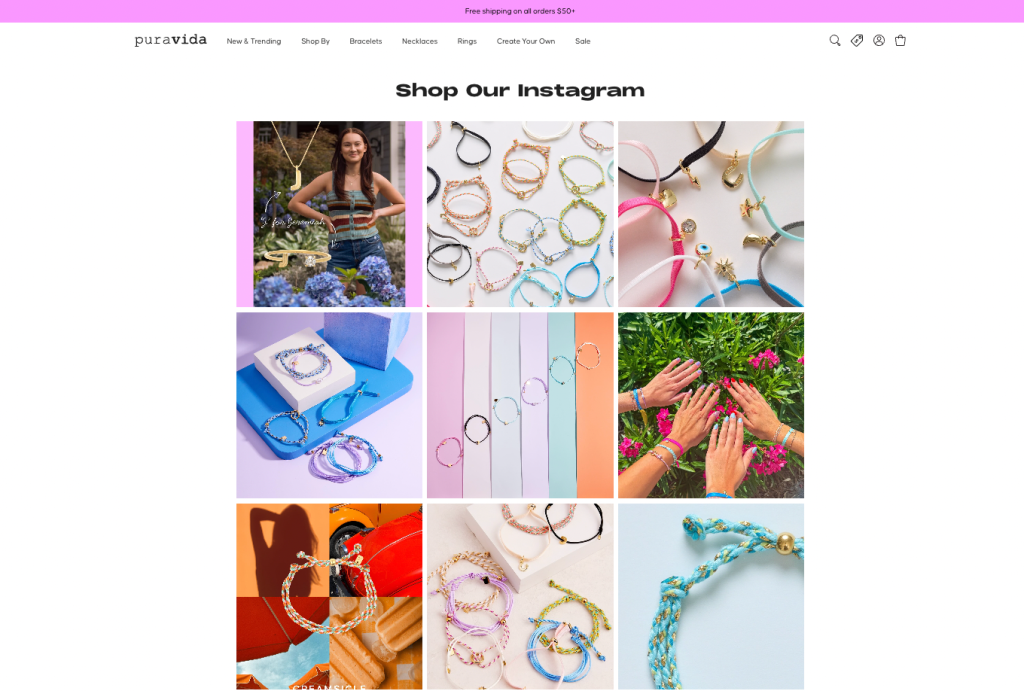
The gallery features a curated selection of top posts from Pura Vida’s Instagram account. Shoppers can click on each image to shop the exact bracelets and other Pura Vida products featured within.
Can you find our tiny logo in this shoppable image?
We’ll give you a hint.
5. Flowbox: Best for global, multi-currency brands
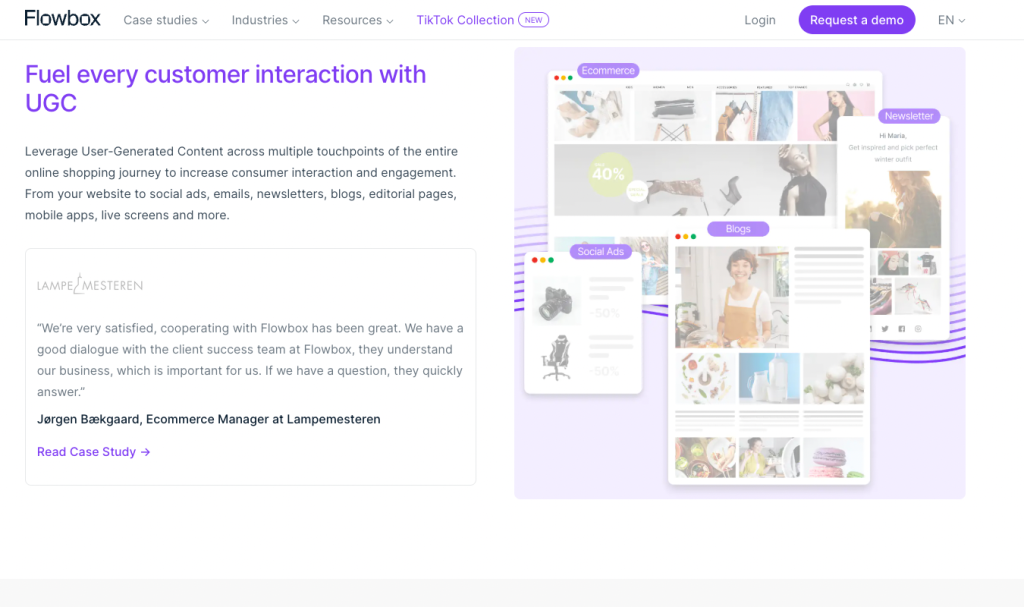
Flowbox is a UGC-driven shoppable content platform, and it’s notable because it’s available in multiple currencies. This means global brands can collect, manage, and publish authentic customer videos and photos across multiple markets.
With Flowbox, you can pull UGC from channels like Instagram, TikTok, YouTube, and Facebook—or straight from your customers. Using Flowbox, you can secure the rights to UGC, tag your products, and then publish them into interactive galleries across your website, product pages, email campaigns, and social media channels.
For brands selling their products internationally, Flowbox supports multi-currency experiences. This means shoppers can see products, prices, and buying options that are relevant to their region.
So, a customer in London, Sydney, or New York can all see the same gallery but with localized product data, currency, and checkout paths.
Key Features
- Ability to pull UGC from multiple platforms and localize it for different markets
- Shoppable galleries will link to localized product pages in the correct currency
- Rights management tools to keep global campaigns legally compliant
- Email and social publishing with region-specific content targeting
- Performance tracking by market, currency, or campaign
Pros:
- Designed for consistent brand storytelling across multiple countries and/or regions
- Supports localized shopping journeys for customers while using one central content library
- Integrates with global ecommerce tech stacks without slowing down site performance
Cons:
- Relies on a steady stream of high-quality UGC from all the countries and regions you serve
- Not focused on live shopping or real-time event formats
Thanks to its multi-country features, Flowbox is best for brands with multi-market, multi-country operations. The shoppable content platform doesn’t publish its pricing, so we can assume it’s more of an enterprise-level tool.
You can request a demo to learn more about whether Flowbox is the right shoppable content platform for you.
Shoppable Content Platforms: A Side-by-Side Comparison Table
Need a quick way to compare the top shoppable content platforms? Here’s a table for you to download:
How to Choose the Right Platform for Your Needs
To pick the best shoppable content platform for your brand, consider these factors:
- Business size/type: Enterprise tools like MikMak or Bazaarvoice are generally better for larger operations. Smaller and mid-sized brands benefit more from an easy-to-understand tool like Foursixty or LTK.
- Target audience: Customers that shop primarily on mobile will probably respond better to Instagram shopping and social commerce tools.
- Monetization strategy: Decide whether you want to split proceeds with affiliates or make strong product links in your owned media assets (like social media posts) a priority.
- Content format: Make sure the tool supports your content marketing mix, whether that’s video content, blogs, short-form, or livestreams.
- Call-to-action flow: A smooth path to purchase is very important for achieving higher conversion rates from your shoppable content.
Common Mistakes to Avoid with Shoppable Content Platforms
- Choosing a platform that doesn’t match your audience’s shopping habits or your own marketing strategy.
- Failing to choose a tool with robust performance analytics—which is key to uncovering what’s converting the customers.
- Overlooking mobile optimization, especially for online shopping on social platforms.
- Poor disclosure of sponsored or affiliate content, which can erode trust in your brand and hurt your conversions.
Key Takeaways for Using Shoppable Content Platforms
Ready to go drum up more interest in your brand—and more purchases—with a shoppable content platform?
Here’s a recap to check back with as you get started:
- Best for Influencers: LTK
- Best for DTC Brands: Foursixty
- Best for Multi-Retailer Sales: MikMak
- Best for UGC Scale: Bazaarvoice
- Best for Global Brands: Flowbox
Pro tips:
- Test multiple tools to see what lines up best with your audience’s shopping behavior.
- Keep refining your shoppable content marketing strategies, and don’t be afraid to switch platforms if one isn’t working for you.
- Focus on connecting product links in the content with strong CTAs in the captions for higher conversion rates.
TL;DR: Match the platform to your audience and strategy, and then test and optimize relentlessly.
Shoppable Content Platform FAQs
What is shoppable content?
Shoppable content is any image, video, or post that lets people buy products directly from what they’re looking at. Think Instagram posts with product tags or a video where you can click to add something to your cart. Shoppable content shortens the shopping journey by turning inspiration into checkout in just a few clicks.
How do you create shoppable content?
Start with engaging visuals—photos, videos, or UGC—that show your products in action. Use a shoppable content platform to add clickable product links and connect them to your ecommerce store. Then, publish the content across social platforms, your website, or email so shoppers can buy right from the content.
Do you require a shoppable content platform to drive sales?
Not always—but it makes the process a lot smoother. Without one, you’ll need to manually link products and track performance across channels, which can be time-consuming. A shoppable content platform automates the clickable parts and integrates with your store.