Quick summary:
The best social commerce platforms in 2026 aren’t the ones with the most features—they’re the ones that compress the distance between product discovery and purchase. Platforms like Foursixty are winning because they connect user-generated content, shoppable posts, and real-time storefront experiences directly to revenue. If your current setup can’t tie video content, influencers, and product pages to actual conversion rates, you’re not running social commerce—you’re running disconnected marketing.
Social commerce isn’t emerging anymore, it’s where your highest-intent customers already are.
The shift is already complete.
Your customers are discovering products on social media UGC platforms like Instagram, TikTok, and even Snapchat, forming opinions through short-form video content, and increasingly expecting to purchase products without leaving the app. According to McKinsey, social commerce is projected to become one of the fastest-growing segments in ecommerce globally—driven largely by Gen Z and mobile-first shopping behavior.
But here’s the catch most ecommerce teams underestimate:
Discovery and conversion are happening in different systems.
That gap is where revenue gets lost.
What Is Social Commerce (And Why It Matters Now)
At its core, social commerce is the integration of shopping experiences directly into social networks like Instagram, allowing users to discover, evaluate, and purchase products in a single flow.
Traditionally, ecommerce worked like this:
Search engine → product page → checkout
Now it looks more like this:
Social feed → shoppable content → product validation → purchase
That difference isn’t subtle—it fundamentally changes how your target audience moves through the funnel.
Platforms like Instagram Shopping, TikTok Shop, and Facebook Shops are pushing this behavior by enabling in-app checkout, product tags, and even live stream shopping experiences. According to Instagram, brands that enable shopping features see significantly higher engagement because the friction between interest and purchase is reduced.
But here’s where many brands get it wrong:
They treat social commerce as a channel, not a system.
What to Look for in a Social Commerce Platform
Once you zoom out, it becomes clear that not all platforms are solving the same problem.
The best social commerce platforms don’t just distribute content—they connect behavior to revenue.
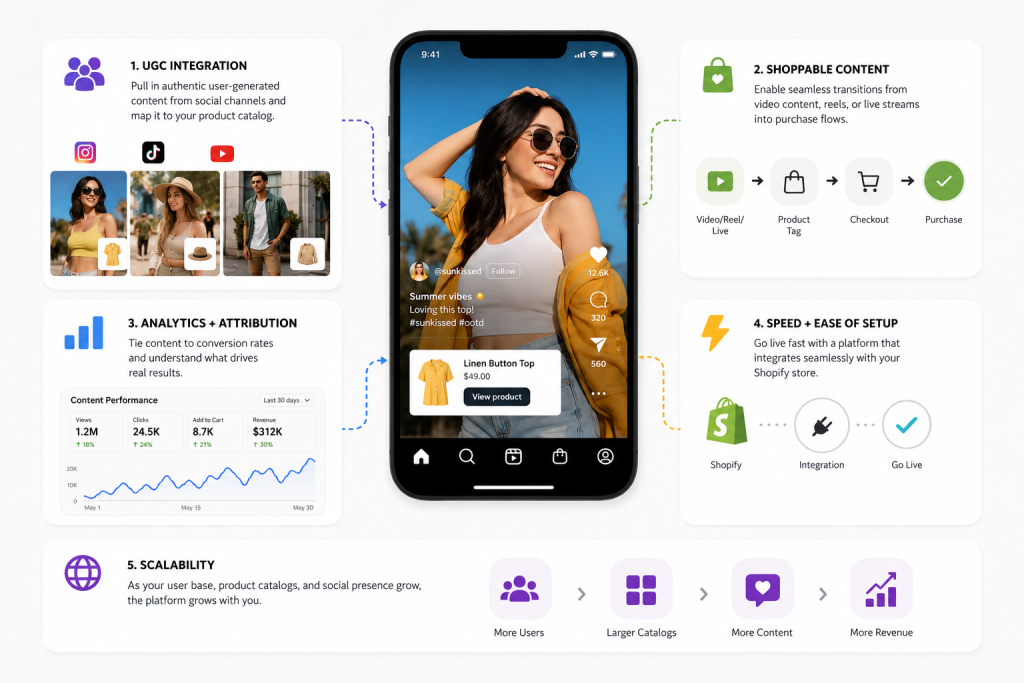
The difference shows up in five critical areas:
- UGC integration
The ability to pull in authentic user-generated content from social channels and map it to your product catalog. This is what turns passive browsing into social proof. - Shoppable content
Not just tagging products—but enabling seamless transitions from video content, reels, or live streams into purchase flows. - Analytics + attribution
If you can’t tie content to conversion rates, you’re optimizing blind. - Speed + ease of setup
Platforms that require heavy dev work delay ROI. The best tools plug into your Shopify ecommerce platform and go live fast. - Scalability
As your user base, product catalogs, and social channels grow, your platform needs to handle it without friction.
Most platforms check a few of these boxes.
Very few check all of them.
Top Social Commerce Platforms Compared
Let’s break down what’s actually happening across the market.
Foursixty

UGC Integration (Social → Storefront)

Foursixty is designed to utilize user-generated content (ugc) directly from Instagram feeds, TikTok, and other social media platforms, then map each asset to your product catalog and product pages. This creates a structured connection between content and commerce, rather than a static feed.
Shoppable Content + Product Tagging
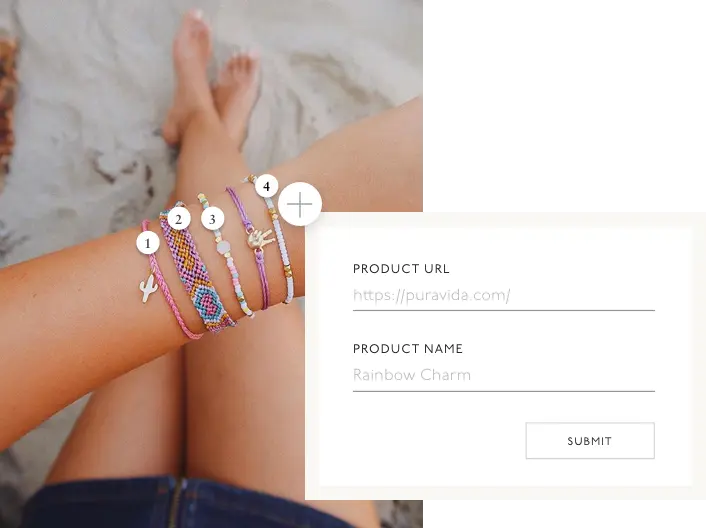
Supports multi-product tags, shoppable videos, and direct linking from content to checkout, enabling full-funnel conversion flows. This is core to the platform’s positioning as a social commerce layer, not just a gallery.
Revenue Attribution
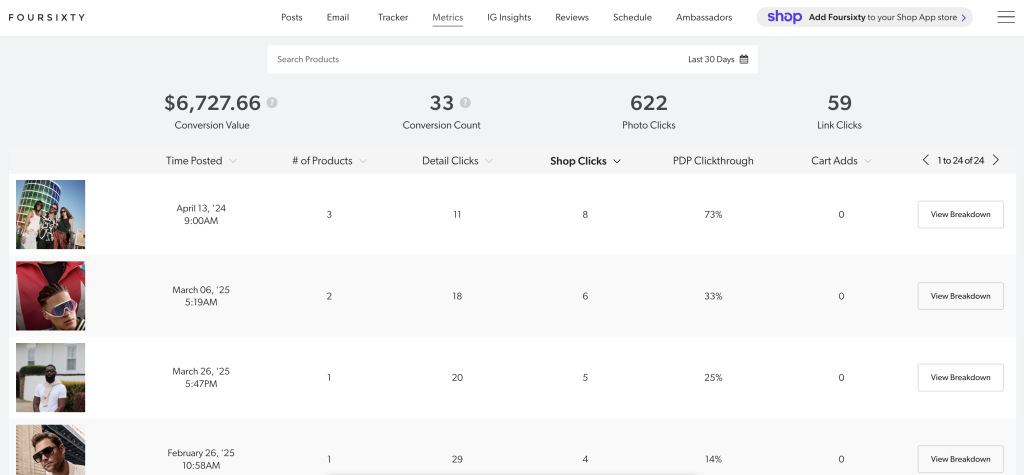
Foursixty provides attribution tied to conversion rates, clicks, and revenue generated from UGC interactions—something highlighted directly in their case studies.
Speed to Launch
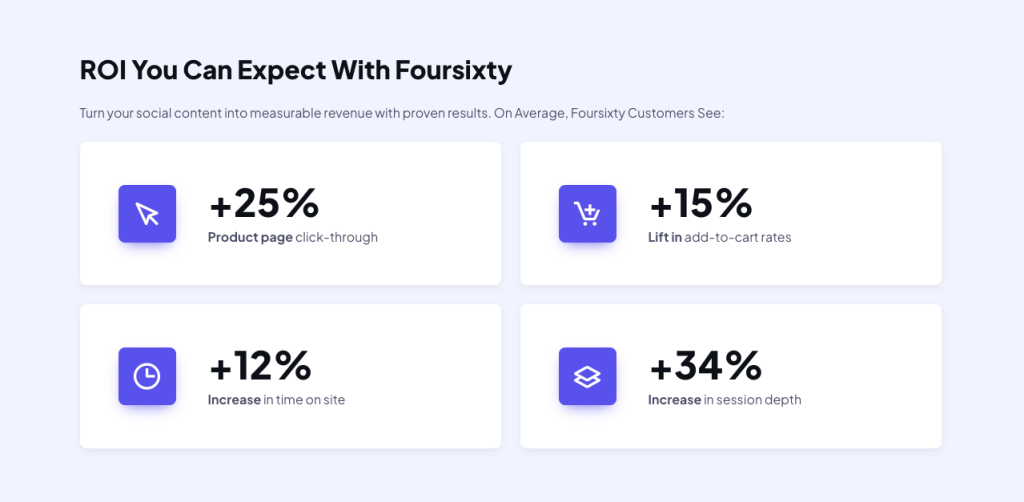
Implementation is designed to be fast, especially for Shopify brands. MICHI’s case shows advanced deployment completed in half a day.
Placement Flexibility

Content can be embedded across homepage, product pages, and other key parts of the storefront, enabling alignment with the buyer journey.
Content Moderation + Rights Management
Includes built-in workflows for UGC rights approval and moderation, allowing brands to safely scale influencer and customer content.
Multi-Channel Support
Primarily focused on high-impact channels like Instagram and TikTok, rather than broad aggregation—prioritizing depth over breadth.
Real-Time Content + Personalization
Feeds update in near real-time, allowing brands to continuously refresh content and highlight top-performing posts.
Mobile-First + Video Commerce
Optimized for short-form video content, including reels and TikTok-style formats, which aligns with current Gen Z shopping behavior.
Scalability + Pricing
Flexible pricing models designed to scale with brand growth and content volume (custom plans vs rigid tiers).
Yotpo
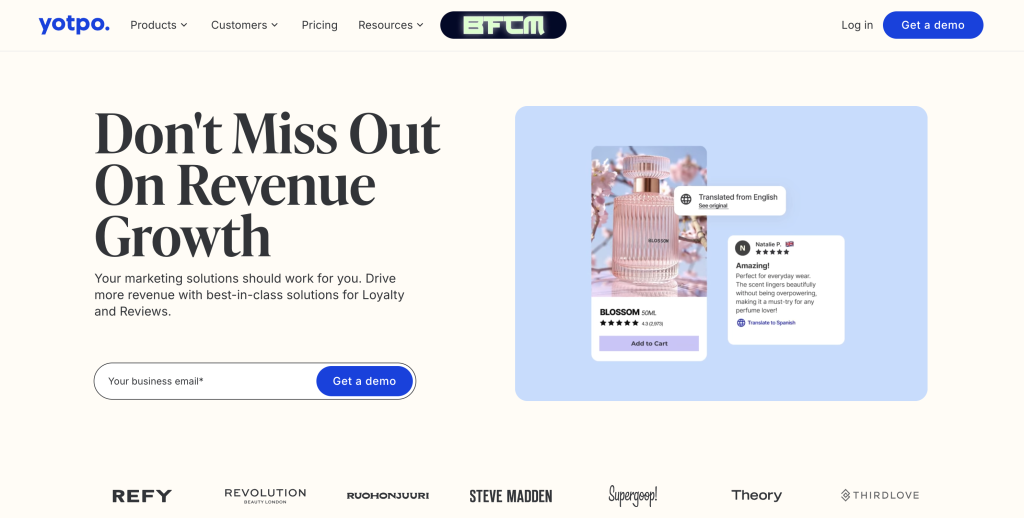
UGC Integration (Social → Storefront)
Yotpo integrates UGC into its broader ecosystem, primarily alongside reviews and ratings rather than real-time social ingestion.
Shoppable Content + Product Tagging
Supports shoppable galleries and tagging, but functionality is tied closely to its review ecosystem.
Revenue Attribution
Provides analytics across reviews, SMS, and campaigns, though attribution is more ecosystem-wide than social commerce-specific.
Speed to Launch
Implementation depends on how much of the Yotpo ecosystem is adopted (reviews, loyalty, SMS), often increasing complexity.
Placement Flexibility
UGC and reviews can be embedded across pages, though often within predefined modules.
Content Moderation + Rights Management
Strong moderation tools, particularly for review content and customer submissions.
Multi-Channel Support
Broad ecosystem including SMS, email, loyalty, and reviews across multiple marketing channels.
Real-Time Content + Personalization
Moderate—less focused on real-time social feeds, more on structured customer content.
Mobile-First + Video Commerce
Supports visual content, but video commerce is not the core focus.
Scalability + Pricing
Tiered pricing model, increasing as more modules are added.
Bazaarvoice
UGC Integration (Social → Storefront)
Focuses on reviews and syndicated content across retailers and marketplaces rather than dynamic social feeds.
Shoppable Content + Product Tagging
Limited focus on direct shoppable content within owned ecommerce experiences.
Revenue Attribution
Strong analytics tied to retail performance, especially across distributed sales channels.
Speed to Launch
Enterprise onboarding and integrations typically require longer timelines.
Placement Flexibility
Highly customizable, but implementation-heavy and resource-intensive.
Content Moderation + Rights Management
Enterprise-grade moderation and compliance systems.
Multi-Channel Support
Extensive support across retail networks, marketplaces, and brand sites.
Real-Time Content + Personalization
More structured than real-time; optimized for consistency across channels.
Mobile-First + Video Commerce
Limited emphasis compared to newer social-first platforms.
Scalability + Pricing
Enterprise pricing model with custom contracts.
Taggbox
UGC Integration (Social → Storefront)
Strong aggregation from multiple social networks, quickly pulling content into a display layer.
Shoppable Content + Product Tagging
Basic shoppable content capabilities, but less deeply integrated into ecommerce flows.
Revenue Attribution
Primarily engagement-focused metrics (views, clicks), with limited revenue attribution.
Speed to Launch
Fast setup via embeddable widgets.
Placement Flexibility
Flexible embedding across sites, though not optimized specifically for product pages.
Content Moderation + Rights Management
Basic moderation tools available.
Multi-Channel Support
Supports a wide range of social media platforms.
Real-Time Content + Personalization
Real-time feeds supported, but limited personalization.
Mobile-First + Video Commerce
Supports video display but not deeply optimized for conversion-focused video commerce.
Scalability + Pricing
Affordable entry-level pricing, scaling with features.
Native Platforms (TikTok Shop, Instagram, Snapchat)
UGC Integration (Social → Storefront)
Native platforms generate the original ugc, influencer content, and video content that drives discovery.
Shoppable Content + Product Tagging
Best-in-class for in-app checkout, product tags, and shoppable posts.
Revenue Attribution
Strong in-platform analytics, but limited visibility once traffic moves to your ecommerce site.
Speed to Launch
Fast activation through platform-native commerce tools.
Placement Flexibility
Limited—brands are constrained by platform UX and algorithm.
Content Moderation + Rights Management
Controlled by platform policies.
Multi-Channel Support
Each platform operates independently – source.
Real-Time Content + Personalization
Industry-leading personalization via platform algorithms.
Mobile-First + Video Commerce
Leaders in short-form, live stream shopping, and mobile-first experiences.
Scalability + Pricing
Free to use, but tradeoff is lack of ownership over data and experience.
Other Platforms (TikTok Shop, Instagram, Snapchat)
Native platforms like TikTok Shop, Instagram Shopping, and even Snapchat are evolving rapidly.
They offer:
- In-app checkout
- Live shopping events
- Algorithm-driven personalized recommendations
But they come with a limitation: you don’t own the experience.
And that matters more than most brands realize.
Real Results from Social Commerce Platforms
This is where the conversation shifts from theory to reality.
Most platforms promise engagement.
Very few show revenue impact.

Take MICHI. After switching to Foursixty, they saw a 51x ROI within 30 days—not because they added more content, but because they aligned content with product discovery and purchase behavior.
Pura Vida’s results tell a similar story:
- 18.2% click-through rate from UGC
- +73% increase in page views
- -34% bounce rate
- 17% of total revenue influenced

The insight here is simple:
Social commerce works when it’s embedded into the buying experience—not layered on top of it.
Which Platform Is Right for Your Brand?
The right platform depends less on your size and more on your operating model.
For small businesses, speed and simplicity matter most. You need something that integrates quickly with your online store, supports influencer marketing, and doesn’t overcomplicate pricing.
For mid-market brands, attribution becomes critical. You’re optimizing conversion rates, managing multiple social channels, and need clear visibility into what’s actually driving sales.
For enterprise teams, scale and partnerships matter. Platforms like Bazaarvoice make sense if you’re distributing across retailers and marketplaces, but you’ll still need a strategy for your owned ecommerce site.
The mistake most teams make is choosing based on features—not outcomes.
Why Foursixty Stands Out
Foursixty stands out because it aligns with how people actually shop today.
It treats user-generated content, shoppable videos, and influencer-driven content as part of the checkout funnel, not just marketing.
It’s built around:
- Fast integration with Shopify
- Seamless mapping between ugc and product pages
- Clear attribution from content → purchase
- Real-time content updates across your storefront
That’s why brands see results quickly.
Because it’s not trying to do everything—it’s trying to do one thing extremely well:
Turn social proof into revenue by starting with Foursixty for Free!
How to Get Started with Social Commerce
Most teams overthink this.
The highest-performing brands follow a simple progression:
First, choose a platform that integrates with your existing ecommerce platform and supports shoppable content.
Then, connect your social media platforms and start pulling in ugc, reels, and video content tied to real customer experiences.
Next, embed that content across high-impact areas—your homepage, product pages, and key landing pages—where customers are making decisions.
Finally, track performance relentlessly.
Because the goal isn’t to launch social commerce – it’s to consistently improve.
FAQs
Which social media platform is best for ecommerce?
It depends on your target audience, but Instagram, TikTok, and increasingly YouTube Shorts dominate ecommerce performance today. Instagram excels in visual product discovery and shoppable posts, while TikTok drives impulse purchases through short-form shoppable video content and algorithmic reach. The best approach isn’t choosing one platform—it’s building a system that connects all of them to your online store.
What is the most successful e-commerce platform?
Platforms like Shopify lead because of their flexibility, ecosystem, and integrations with social commerce platforms. Shopify enables brands to connect product catalogs, manage customer support, and integrate tools like Foursixty for shoppable content. Success isn’t just about the platform—it’s about how well it integrates with your broader social commerce strategy.
What are the top 5 social platforms?
The top platforms for ecommerce right now are Instagram, TikTok, YouTube, Facebook, and Snapchat. Each offers unique shopping features, from live streams to product pins and in-app checkout. The real opportunity comes from combining them into a cohesive ecosystem, not treating them as isolated channels.
What do Gen Z use instead of Facebook?
Gen Z is heavily concentrated on TikTok, Instagram, and Snapchat. These platforms prioritize video content, authenticity, and community-driven discovery—making them ideal for social selling and influencer marketing. Facebook still plays a role through Facebook Shops, but it’s no longer the primary discovery engine for younger demographics.
What are the Benefits of Social Commerce Platforms?
Social commerce platforms reduce friction between discovery and purchase, improve conversion rates, and enhance brand awareness through social proof. They allow brands to integrate ugc, live shopping, and personalized recommendations directly into the buying journey. Ultimately, they help drive sales by aligning with how customers already behave.
What is social ecommerce platform?
A social ecommerce platform is any tool or system that enables shopping directly within or alongside social media platforms. This includes native tools like TikTok Shop and external platforms like Foursixty that bring shoppable content onto your ecommerce site. The goal is to connect social discovery with purchase in a seamless flow.
Is Facebook an ecommerce platform?
Facebook itself isn’t a traditional ecommerce platform, but Facebook Shops allows brands to create storefronts within the app. It supports product catalogs, in-app browsing, and integrations with platforms like Shopify. However, most brands still rely on their own ecommerce site for full control and optimization.
What role does influencer marketing play in social commerce?
Influencer marketing is one of the primary drivers of social commerce. Influencers create authentic ugc that builds trust and accelerates product discovery. When paired with shoppable posts and product tags, influencer content becomes a direct revenue channel—not just a branding tool.
Do you want to know which social media platforms offer the best social shopping experience?
The best experiences come from platforms that combine content, community, and checkout—like TikTok Shop and Instagram Shopping. These platforms offer in-app checkout, live stream shopping, and highly personalized feeds driven by their algorithm. However, the strongest strategies extend these experiences onto your own storefront.
How can small businesses leverage social commerce effectively?
Small businesses should focus on speed and simplicity. Start by integrating a tool that connects your social media platforms to your Shopify store, then leverage ugc and influencers to build trust quickly. The goal is to create a seamless path from product discovery to purchase without overcomplicating the stack.
What are the best social commerce platforms for boosting e-commerce sales?
Platforms like Foursixty, TikTok Shop, and Instagram Shopping lead because they combine shoppable content, video, and strong conversion pathways. Foursixty stands out for on-site conversion, while TikTok and Instagram dominate discovery. The best results come from using them together.
Which social commerce platforms are most effective for boosting online sales?
The most effective platforms are the ones that connect social proof to checkout. TikTok Shop excels in impulse buying, Instagram in visual validation, and Foursixty in converting that behavior on your ecommerce site. Together, they create a full-funnel social commerce ecosystem that consistently drives revenue.