The product detail page (PDP) is the most decisive moment in an online shopping journey. It’s where potential customers become buyers—or bounce. Traditional optimization relied on A/B testing, UX tweaks, and manual CRO checklists, but scaling to thousands of SKUs makes that unsustainable.
Enter AI-powered PDP Optimization. Using machine learning and generative AI, brands now automate copy, personalize layouts, and test visuals in real time. McKinsey reports AI personalization can lift conversion rates by up to 20 %. For serious eCommerce leaders, AI for PDPs isn’t futuristic—it’s foundational.
Where AI Can Impact PDPs
AI is reshaping how shoppers interact with product pages—from first glance to final click. Five use cases where AI models are leading the charge are:
Product Descriptions & Content
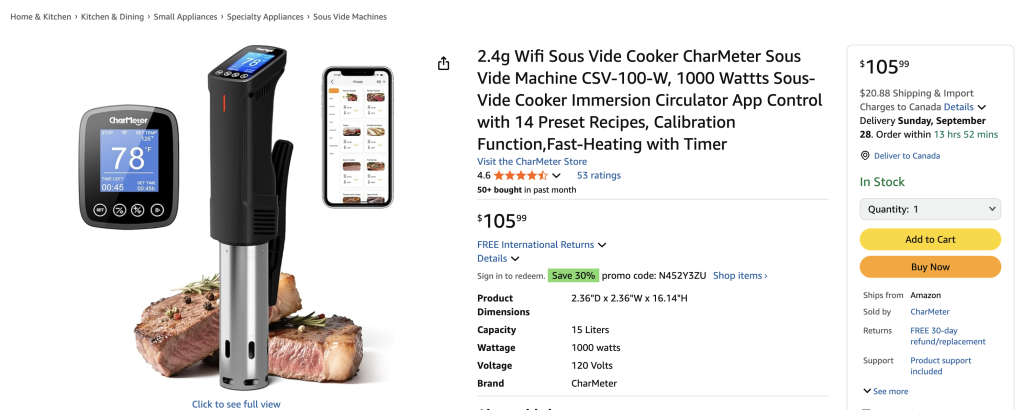
Natural-language generation (NLG) tools such as ChatGPT, Jasper, or Writer automatically create SEO-optimized product descriptions matched to tone and persona. These AI-generated assets maintain consistency across languages and metadata while freeing teams for strategy.
Dynamic copy layers even adjust by intent—first-time visitors see trust-building lines, while returning buyers see loyalty perks. This reflects the psychology of selling online, using emotion and logic together. Foursixty clients applying AI-assisted PDP content have recorded up to a 15 % lift in product page conversion rate, driven by faster updates and richer search coverage.
Visual Optimization

AI now powers visual refinement. Platforms like Veesual and Photoroom generate alternate backgrounds, lighting, and model imagery using generative AI, enabling constant image testing without reshoots.
In fashion, small changes matter. A men’s apparel retailer in Foursixty’s dataset applied AI-assisted smart cropping and alt-tag optimization to its shoppable UGC, reducing bounce by 18 %. For high-intent shoppers, realistic fit visuals directly raise add-to-cart rate—proof that smart imagery is conversion infrastructure.
Personalization & Recommendations
AI recommendation engines analyze user behavior to personalize PDPs. Shoppers see bundles, color variants, or UGC strategy blocks most relevant to their profile.
Through AI for PDPs, retailers dynamically swap trust badges, testimonials, or creator photos—real social proof in eCommerce that builds instant confidence. The effect: higher relevance, smoother journeys, and measurable boosts in engagement metrics.
A/B and UX Testing with AI
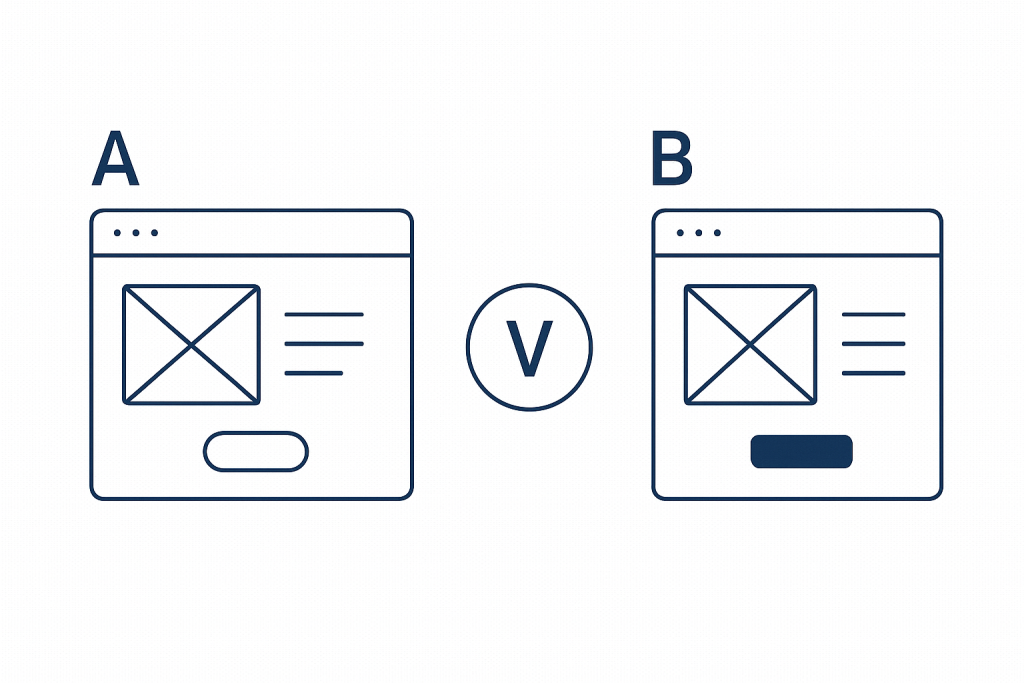
Predictive AI compresses traditional test cycles. By reading historical heatmaps, scroll depth, and CTA button data, algorithms like Intellimize or Convert.com forecast winning PDP variants before deployment.
In Foursixty’s men’s apparel analysis, PDPs emphasizing fit clarity (model stats, fabric info, “shop-the-look” modules) generated 1.5–2× more interactions than static pages—demonstrating that machine-learning-guided UX design drives faster, evidence-based iteration.
Accessibility & SEO Optimization
AI enhances inclusivity and discoverability. It generates alt text, repairs schema markup, and synchronizes PIM data for consistent digital shelf accuracy. These automations raise organic visibility and ensure compliance—serving both algorithms and humans.
Real-World Examples of AI-Enhanced PDPs (Based on Foursixty Data)
Across 11 men’s apparel eCommerce sites, Foursixty analyzed 20 million+ interactive events—product image clicks, collection exploration, and add-to-cart actions. The findings show how AI-assisted UGC integration and smarter PDP design transform engagement.
- Concentrated engagement drives impact. The top 10 % of stores averaged 84 000+ monthly interactive events, capturing 60 % of total activity. These leaders used AI-driven PDP content enrichment—automatically surfacing relevant UGC or re-ordering “shop-the-look” modules—to hold attention longer and deepen trust.
- AI-tagged UGC boosts depth. Sites using intelligent UGC placement achieved substantially deeper session depth and more conversion signals than static catalogs. Heatmap data showed PDPs with AI-selected social proof were scrolled 25–30 % further on average.
- Operational takeaway. In men’s fashion, efficiency equals engagement. AI-powered PDP optimization—anchored in behavioral analytics and UGC relevance scoring—turns clarity and credibility into measurable ROI.
This proves that real-world, data-driven UGC PDP content can move the needle on both add-to-cart rate and conversion metrics.
Tool Stack for AI on PDPs
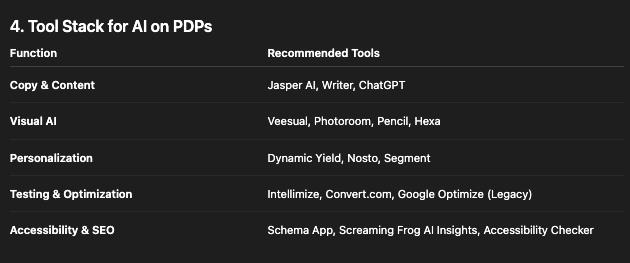
Together, these tools build an AI ecosystem spanning description generation to behavioral testing.
Implementation Challenges to Watch For
- Voice consistency: Generative tools need brand-tone constraints.
- AI hallucination: Automated content must be verified for factual accuracy.
- Legacy integration: CMS/PIM systems often require API middleware.
- Over-automation: Excessive dynamic modules can overwhelm site visitors.
Transparency about limitations reinforces trustworthiness, a core E-E-A-T signal.
Future of PDPs: Generative UX
Tomorrow’s Generative PDPs will self-configure layouts, media, and copy in real time. They’ll recognize returning users, prioritize loyalty offers, and even integrate Shopify linking to Instagram Reels for contextual commerce.
By 2026, expect multi-modal PDPs combining voice, image search, and predictive UI—powered by AI-driven UX conversion optimization and underpinned by authentic UGC strategy.
Conclusion
AI is no longer optional for PDPs—it’s the backbone of scalable personalization. The winning strategy pairs machine learning precision with human creativity: generate, test, and adapt continually.
To see how Foursixty’s UGC embedding and AI-assisted PDP workflows improve engagement across apparel, beauty, and home goods, request our AI for PDPs audit checklist or schedule a strategy demo.
FAQs
What is the 30 % rule in AI?
Roughly 30 % of repetitive tasks can be automated by AI without losing quality—think description creation, tagging, or image optimization.
What are the 4 types of AI?
Reactive machines, limited memory, theory of mind, and self-aware AI. PDP tools sit in the limited-memory tier, learning from behavior to improve layouts.
Is PlayStation using AI?
Yes—its recommendation and UX layers mirror how eCommerce platforms use AI to personalize PDP experiences.
Is Photoshop obsolete with AI?
No—its Firefly suite automates creative edits, making content creation for PDP optimization faster than ever.
What are Generative PDPs?
Pages that auto-rearrange copy, imagery, and modules per visitor in real time.
Do Shoppers Trust AI-Generated Images?
In Foursixty’s 20 M-event dataset, bounce rates fell when AI-tagged UGC was clearly labeled as authentic, showing that transparency builds trust.
How Will Spending Habits Change in 2026?
Consumers will expect frictionless, personalized shopping; AI-driven confidence will replace discount-driven impulse.
Why High-Quality Visuals Matter for AI Discoverability
Clean, accurate imagery with structured metadata helps AI ranking systems surface your SKUs across the digital shelf.
What role does schema markup play in PDP optimization?
It tells search engines your price, reviews, and availability. AI can auto-detect schema errors to boost search visibility.
How is AI transforming product detail pages in eCommerce?
By automating content creation, testing UX variants, and personalizing every session—merging creativity with data for higher conversion rates.